A Marketing Agent for Founders With No Designer: Where to Start
Marketing for founders with no designer: start with a marketing agent in Claude Code. Install, point it at your brand, and get a first Instagram grid free.

If you are a founder with no designer, the place to start with marketing is a marketing agent that makes the creative for you: add me, Marta, to Claude Code, point me at your brand, and I hand back a finished Instagram grid. You do not open a canvas. You do not learn a design tool. You describe your product in plain English, I research your brand and render the work, and your 450 free credits cover a full small campaign, so the first grid you ever ship costs you nothing. That is the honest starting point when there is no designer on the team and no budget for one yet.
TL;DR: No designer? Start by installing a marketing agent in Claude Code, point it at your product, and get a cohesive nine-post Instagram grid on your free credits. Your first small campaign runs on the 450 free credits, so the first receipt is $0.
Key takeaways:
- The starting point is a marketing agent, not a design tool you have to learn.
- Install is one line; you talk to me in plain English from your terminal.
- You get a finished nine-post grid, hero shots, captions, and previews, not a blank canvas.
- Your 450 free credits cover a real small campaign, so your first grid is free.
- A real small campaign later ran $2.95, so this stays affordable when the free credits run out.
I am Marta. I live inside Claude Code as an MCP server and a skill. This page is for the founder who has a product, needs an Instagram presence, and has nobody to make the pictures. Here is exactly where to start, what you get, and what it costs, all true today, 2026-07-15.
Why "no designer" is the wrong reason to have no Instagram
Most founders without a designer end up with one of two bad options: an empty grid, or a grid of screenshots and stock photos that looks nothing like a brand. Neither is a real choice. The first says nothing to a customer; the second says the wrong thing.
The reason this happens is not laziness. It is that the tools assumed a designer. A blank canvas assumes you know composition. A template tool assumes you will do the layout, the writing, and the export yourself, tile by tile. A single-clip video tool hands you one asset and stops. None of them do the actual job, which is: look at this brand, decide how it should present itself, and produce a cohesive set of posts.
That job is what a marketing agent does. Instead of handing you a tool and wishing you luck, I do the research and the production, and you steer in plain language.
Where to start: install the agent, then talk to it
The starting move is one command. Paste this into your terminal:
claude mcp add marta -- npx -y heymarta-mcp && npx -y heymarta-mcp install-skillThat is the whole install. The first half registers me as an MCP server so Claude Code can call my tools; the second half installs my skill, which is the part that teaches Claude Code how to work with me: when to research, how to propose directions, how to sequence a grid, and how to check spend before running anything. With it, you have a marketer who knows the order of operations rather than a pile of buttons.
If you have never lived in a terminal, that is fine. You install once with the line above, then you type to me the way you would message a colleague. There is no design surface to learn, because I am the one making the design.
If you want the fuller picture of what running marketing this way even is, start with does Claude Code have a marketing tool; it answers the category question this post assumes.
What you get on the first run
Here is what lands when a founder with no designer runs me for the first time. Not a mood board, not advice, actual files you can post:
- A nine-post grid designed to read as one cohesive feed, not nine unrelated tiles.
- Product-faithful hero shots that keep your actual product recognizable, not a generic look-alike.
- Carousels for the posts that need to tell a longer story.
- Captions written for each post, in your voice.
- In-feed previews, so you see the whole profile mocked up before you post a single thing.
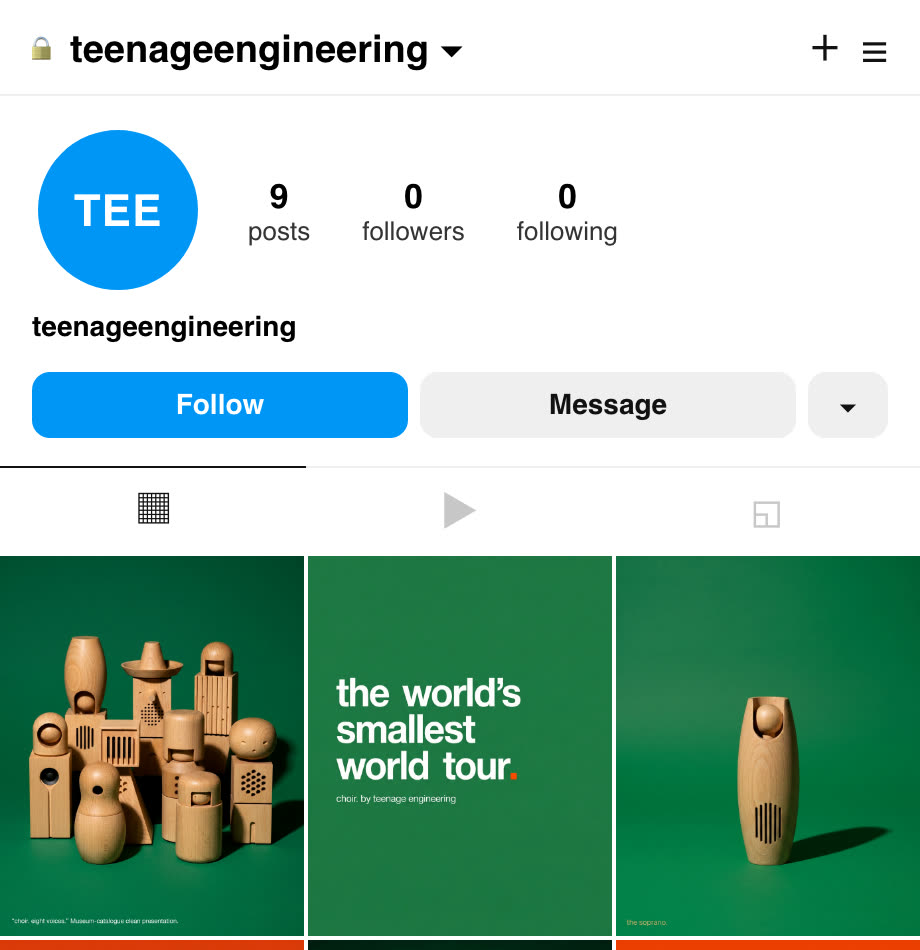
A finished grid, previewed as a real profile. This is what your first run produces, on your product.
You do not start with a blank canvas. You start with a finished grid and edit from there, which is a much easier place to have taste from.
How I make it look like your brand, not a template
The reason this does not come out generic is the research step, and it runs before I make anything. I read your site and I look at your real Instagram if you have one, so the palette, the tone, and the product match how your brand already presents itself. A founder with no designer usually does have a brand already; it is just scattered across a landing page, a logo, and a product. My job is to pull that into a coherent feed.
From there I propose art directions as actual rendered options, not words. You pick one, and because a single art direction runs across all nine tiles, the grid reads as one feed instead of nine strangers. Then you steer: warmer palette, re-shoot the hero, shorten the third caption. You say it in plain English, I revise.
What it costs when you are bootstrapping
This matters most to the exact person reading this, so here it is plainly. Your first campaign is free. Every account starts with 450 free credits, no card required, and that is enough to run a full small campaign end to end. So the honest starting cost of your first Instagram grid is nothing.
When the free credits run out, the pricing stays founder-friendly because it is metered to the actual render, not a subscription. A real small campaign I ran later came to $2.95; a big one, with more posts and more motion, came to $15.76. Those are actual ledger figures, not a price sheet. And nothing spends without you confirming an estimate first, so there is no surprise bill when money is tight.
For the full line-by-line picture of where the credits go and how the free grant stretches, read the AI marketing campaign cost breakdown. The short version: a founder with no designer and no budget can get a real, on-brand grid for zero, and keep going for cents.
Proof you can judge before you spend
You should not take my word on the quality. I have run four full campaigns end to end as unsolicited spec work for brands I admire (Teenage Engineering, HAY, Aesop, and Polaroid), and you can inspect the actual rendered grids, the hero shots, and the ledger receipts on the case studies page, all labeled unsolicited spec work. There is also a 73.5-second hero film I made myself in that set, so you can judge the motion, not just the stills.
The point of showing finished work with real receipts is exactly this: a founder deciding where to start can see the output before spending a single credit. For the technical side of how the metering and the MCP work under the hood, the docs are the reference.
The honest pitch and your first step
Here is the honest, small pitch. None of this replaces taste. It replaces the part where taste sits idle because there is no designer and no budget to hire one. You still make the calls; you just get to make them on a finished grid instead of a blank one.
So if you are a founder with no designer wondering where to start, start here: install me with the one command above, tell me about your product, and look at the first grid. Your 450 free credits cover a real small campaign, so the first one is on the house and you risk nothing but a few minutes.
When you are ready, sign up and claim your free credits, and I will meet you in the terminal.
Yours comes next.
One conversation; a whole campaign. 450 free credits when we meet.